Home / Mountains / Mount Meakan
Mount Meakan 阿寒岳

| Elevation | 1,499 m (4,918 ft) |
|---|---|
| Location | Hokkaido, Japan |
| Region | Hokkaido |
| Famous Mountains list | No. 4 of the 100 Famous Japanese Mountains (Nihon Hyaku-meizan) |
| Coordinates | 43.38611° N, 144.00889° E |
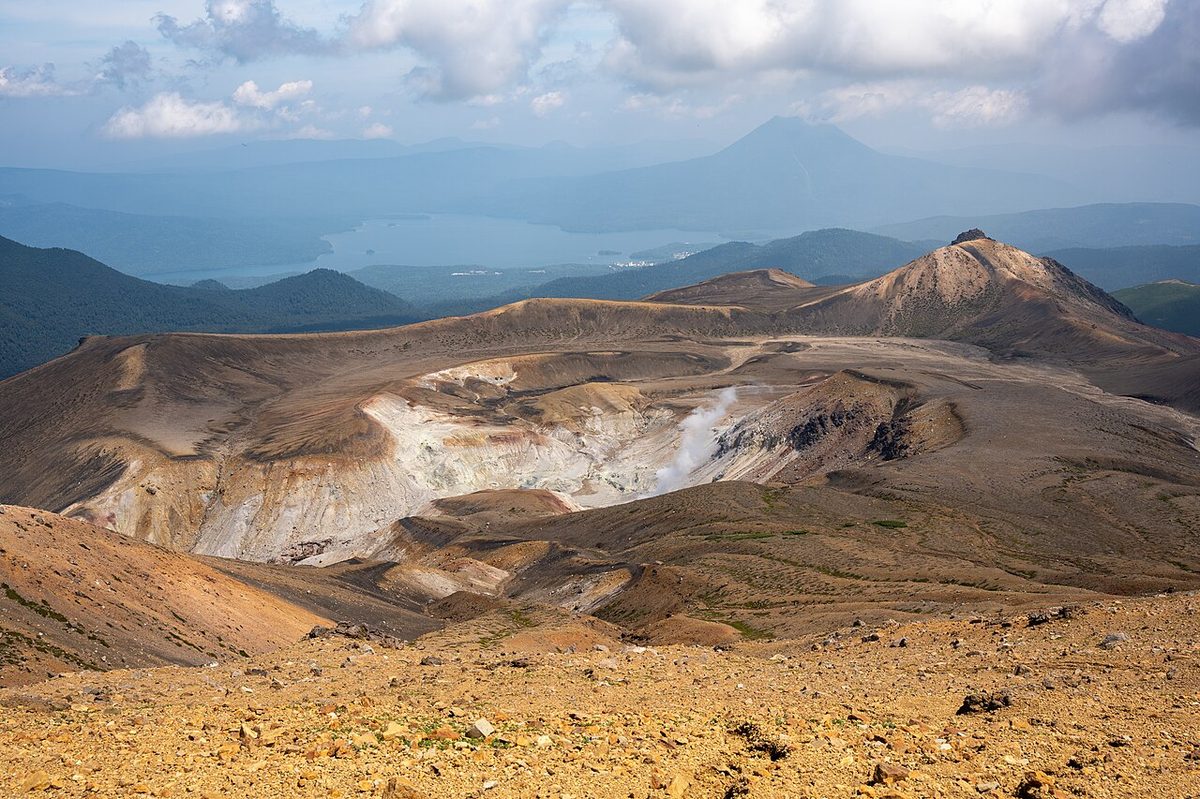
The female Mount Meakan is the name of the total number of submersible volcanoes made up of eight volcanoes in the south of the cold caldera in east of Hokkaido. The main peak is the Pommaticinesilyclym. 1,499 meters. "Mount Meakan" and "Mount Meakan" are listed in the the 100 Famous Japanese Mountains by Narita Kura.
Overview
Not only are they in Toyo and Hajiji, but also are also in the showrooms. It was once called "Mamiestili" in the Ainese language, and male Mount Meakan was called "Pinesili Man's Will." The female Mount Meakan is composed of eight volcanoes, such as the Pommamathari and the Amateur Fujisawa. Pommaticelli is the main peak of the highest Mount Meakan at 1,499 meters. In 1959 and recently in 1998, when the author and climber, Harada Kuichi, visited, there was a small eruption of ash that was observed around and the mountain was banned and removed. A small eruption occurred on March 21, 2006. At the top of the summit is a monument to the mourning of the elementary school student who died on the climb due to lightning in 1972.
Geography
There is a lake in the vicinity of these volcanoes where lava flows from the surrounding rivers, and the lake that is famous for it is located at the foot of the XXQ023X, but many cruise ships fill the lake's surface and are "surrounded " along with the hot springs by the lake. In the area around Mount Meakan, there is also a lake called Penketo and Panketo, and the evil of access leaves a primitive atmosphere without tourist development. At the base of the female Mount Meakan, there are the Onneto, once called a secret lake. It's said that there was a giant caldera eruption in the past, and that the result was that the lake was formed, but we don't know the details yet.
A volcano activity
There is exhilaration activity at the mid-marithic vent on the northeastern side. There is a small swamp with heavy rain on the bottom of the crater of the Pommaticines' crater. In the past, there used to be red swamps, green swamps, red swamps, and three swamps, but since the late 80s, because of the rise in the earth's heat due to volcanic activity in the late 80s, the red swamps have dried up, and only the red and the blue swamps have been seen. A weather station's regular observation volcano has set up seismographs and controlometers to observe volcanic activity and the vibrations of air associated with eruptions. On December 16, 2006, an eruption alert level was introduced.
The formation of the volcano
The volcanic activity began some 13,000 years ago, and after that, there were three - term bursts of blasts at the intervals of 3,000 to 4,000 years. Western mountains, northern mountains, and Pommaticelli were mainly formed by lava from volcanic activity 3,000 years ago. In addition, Miho Sahito was formed from basalt lava and falling burns by volcanic activities of about 2,000 years ago.
The history of the eruption
Although volcanic activity is mainly carried on at the Pommmaine and midmidine fire, and is known to be active in frequent eruptions, there is no known activity prior to the early 1900 ' s when inhabitants entered the area where they could see the female Mount Meakan. It is thought that the surrounding volcano is a depopulated area where no roads and roads, no shelters, and no shelters are available, and that there will be no direct damage unless there is quite a large eruption. The eruptions since history have been caused by the steam explosion - the eruptions of the mamama water vapor. There's a series of rhythms between July 1951 and February 1952. In March 1952, after a ten-year-old earthquake, the sound went off for several days. 1954 - 1961, a series of small eruptions and ash falling. The wind at the time of the eruption is heading north to the network city of 70 kilometers (70 kilometers) and 40 kilometers (40 kilometers) east to the city of Bajita. In 1964 -- 1966, a series of small eruptions. January 5 to 6, 1988, a small eruption. On January 8, 1988, there was a small eruption and a very small amount of ash on the shores of the Ak cold lake. February 7 to 8, 1988, a small eruption. On February 18, 1988, there was a small eruption and a small amount of ash on the shores of the lake. On November 21st, 1996, a small eruption. On November 9, 1998, a small eruption. On March 21st, 2006, a small eruption. On November 18th, 2008, a small eruption. A small eruption on November 28th to 29, 2008. It's September 12, 2025. It's September 15, 2025. A small eruption on October 25, 2025. On March 8, 2026, a small eruption.
- Plantation
The base of the mountain is a forest area, and many species are common in the natural forests of Hokkaido. When you go up to nearly 900 meters, you'll get a high pine forest and you'll open your heart to it. And if you cross a hundred meters, you'll get an elevated plant belt. Of the alpine plants seen in this mountain, two species of Mecankini and Mecanfusma are named after this mountain. What was first discovered was this mountain, which is still seen by many today, but is not unique to this mountain. At altitudes of more than 4,000 feet [1,200 m], most are volcanic gravel, where alpine plants abound. There used to be a number of mushrooms called "queen of alpine plants," even near the mountain road, but the thieves of climbers have lost a lot of money. In the Hiami belt in the middle of the world, honey grows in the fall, but female Mount Meakan is forbidden because it's located in a national park that has ice cream.
Climbing
The climbs include the Onneto Coast from the Ontario National Camp and the Shee Cold Springs Coast from the Sheen and the Lakes West from the Great Lakes.
It's a tradition by Anne
The Nene people who saw the female Mount Meakan, with smoke from the crater and no vegetation caused by volcanic activity, have developed a variety of legends to interpret it as being "stumbled by mountain conflicts, speared by spears, and spread pus from the wounds." This is an example of that. XXQ2XXXXXXXXXXMount MeakanX is a couple's mountain, but male Mount Meakan surrounded the small mountain at the back of the camp. When the demon god Ninemoi found out about it, he said, "It's impertinent to have a leopard like a mountain," and he speared him to the point of being a free woman. The female cold crater says it's that scar. The Daisetsuzan Volcanic Group's Optatecke and the female ZXXQ023X were husband and wife. But then the quarrel broke up, and she got back to her parents. The woman who gave me the chance to get away with it one day threw a spear at the far end of her eye. The ten winning Mount Nupussi, who saw it, was surprised to try to stop them, and they cut off one ear. After learning of the disturbance, the opossum threw a spear and struck it in the shear cold, so she still carries pus from the wound. It's still a separate lake where the waters filled the place of the nuptial who stood up to stop the spears.
Text adapted from the Japanese Wikipedia article 雌阿寒岳, whose full text was translated into English for this guide by its contributors, licensed CC BY-SA 4.0. Elevation and location facts cross-checked with Wikidata (CC0) and the 100 Famous Japanese Mountains list (Japanese Wikipedia, CC BY-SA 4.0).